
Compute Bottleneck: The Hardware Cost of Sustaining the AI Boom
Driven by staggering AI forecasts, hyperscalers are aggressively expanding their CapEx quarter after quarter, triggering severe semiconductor and memory shortages. However, with infrastructure spending vastly outpacing near-term software revenues, could a potential bubble be forming?


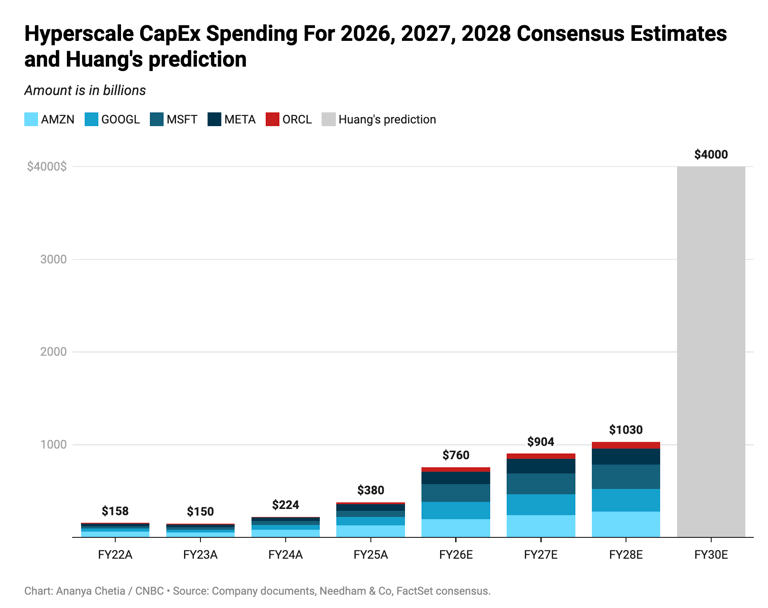

Wall Street is currently fixated on a singular debate: Is AI the greatest technological paradigm shift in human history, or are we witnessing a gigantic market bubble?
I don't have the audacity to say that I know what is happening (and please do not trust anyone who would say so) but we need to look at the numbers. The consensus shows that hyperscalers will pour massive amounts of capital into infrastructure in the coming years, with trajectories pointing toward $1.03 trillion by 2028 and a staggering prediction of $4 trillion for 2030 by Jensen Huang, CEO of Nvidia.
This wave of capital has pushed financial markets into uncharted territory. In current macro analysis, the "AI boom" has driven the S&P 500 well above its 2009 secular trendline and its 150-year central trendline. If we stick only to the statistics, we can see that the stock market is due for a correction.
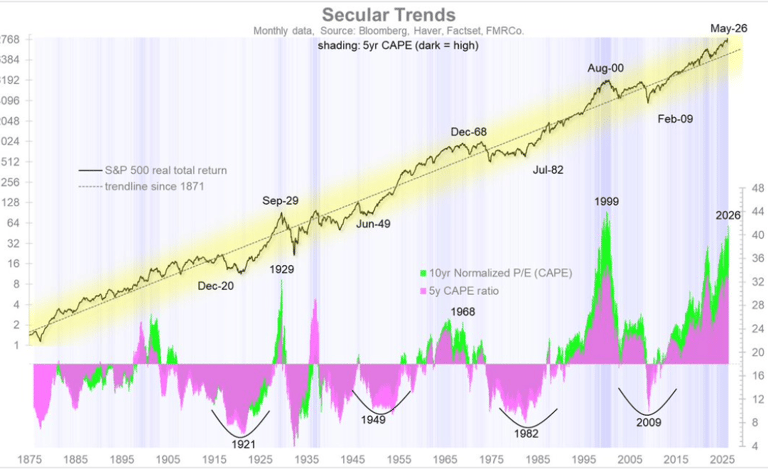

Now, here is the trick, while current valuations stretch to elevated levels and flash warnings of an overheating cycle, viewing this purely as a financial bubble misses the deeper structural reality. Some memory companies which skyrocketed in the past year are still trading at low forward P/E ratios: Micron (x9.5), Sk Hynix (x9.5), SanDisk (x14) or Samsung Electronics (x2.5).
Who is paying for Artificial Intelligence?
To understand the sustainability of this cycle, we have to look at the flow of capital. Right now, the AI ecosystem is operating on a somewhat circular financing loop. Hyperscalers are writing massive checks to Nvidia and its supply chain network (Lumentum, Marvell, Taiwan Semiconductors, Sk Hynix, Coherent, Lumentum and Broadcom to name a few), but the ultimate end-user demand remains the elephant in the room. Does generative AI currently possess a commercial use case that generates enough income to justify a trillion-dollar infrastructure build-out?
Historically, financial markets fall victim to Amara's Law: we consistently overestimate the short-term impact of a new technology while underestimating its long-term potential. Right now, Wall Street is pricing in the long-term potential as if it will materialize next quarter. The critical question for the next 24 months is whether this unprecedented infrastructure spending will yield tangible, high-margin software revenues, or if it will morph into a massive, Facebook Metaverse-style cash bonfire in 2022.
That said, the long-term reality is undeniable. Nvidia is fundamentally rewriting the technological landscape, and compute power is rapidly transitioning from a corporate tool to sovereign infrastructure. Just as data and software have been weaponized as strategic geopolitical assets (look at defense-tech giants like Palantir). Nations are now racing to secure their own domestic AI hardware capabilities.
Nevertheless, trees do not grow to the sky. Nvidia's stratospheric earnings growth will eventually face the law of gravity. When that deceleration occurs, whether triggered by a temporary pause in Mag 7 spending or a hardware transition cycle, it will force a massive market breather. This correction will likely wash out the speculative frenzy, even as the foundational utility of the technology remains perfectly intact.
The CapEx Crunch: Monitoring Hyperscalers Spendings
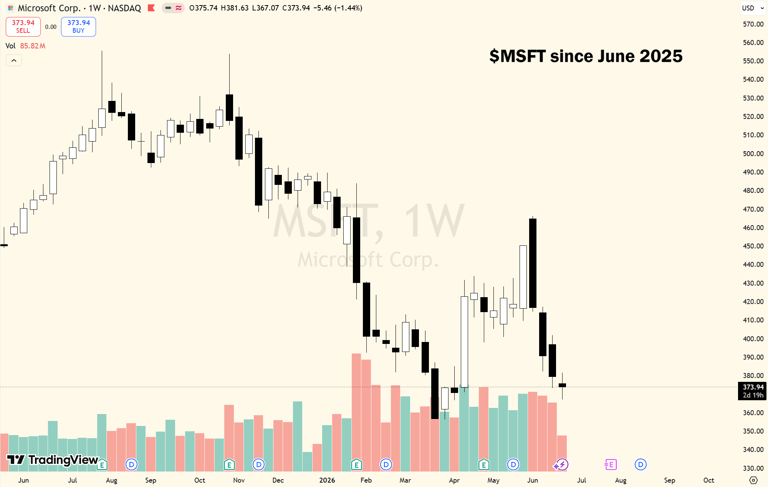
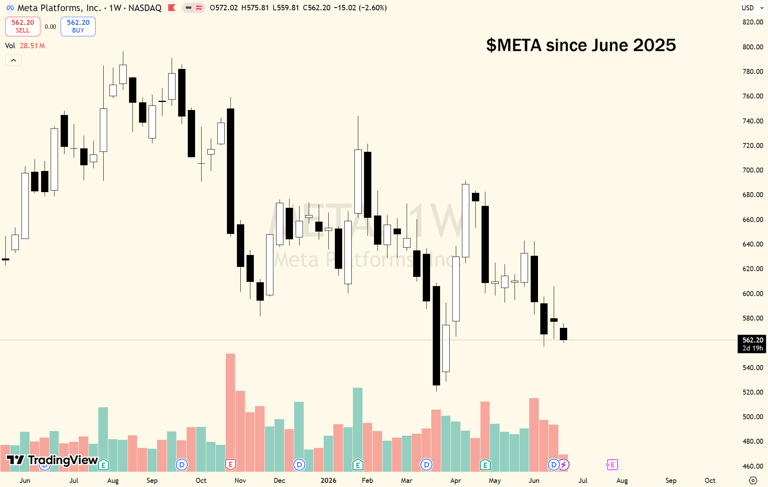
The sheer scale of this infrastructure build-out is beginning to fracture the balance sheets of the world's largest tech companies. Hyperscaler capital expenditures are aggressively eating into their Free Cash Flow: $META with $20 billion and $GOOG with $35 billion in Q1 2026 and guidance for $120+ billion and $85+ billion. A reality that the market has brutally punished during recent quarterly earnings calls. Take a look at $MSFT and $META poor performances since last year.
We are transitioning from a phase of "growth at any cost" to a realization of liquidity constraints. As FCF compresses, several hyperscalers are being forced to tap into debt markets to sustain their AI arms race. The market is not viewing this pivot favorably; borrowing at current interest rates to fund speculative data center expansions shifts the narrative from visionary tech leadership to high-stakes gamble!
The Software Paradox: Value Traps in SaaS?
While capital flows aggressively into hardware, the software sector, particularly SaaS, is experiencing a severe identity crisis. Historically robust businesses with high recurring revenues are currently being punished by market actors, falling into two categories:
The Disruption Victims: Legacy SaaS and data giants (Adobe, Salesforce, Intuit, SPGI, ADP, and even Netflix) are being discounted under the assumption that generative AI will commoditize their moats or replace their human-centric workflows entirely.
The Laggards: Mega-caps like Amazon and Apple, and even Microsoft as we just mentioned previously are somehwat considered software stocks. Despite Microsoft ties to OpenAI the stock face market skepticism whenever their immediate AI monetization strategies appear slow or opaque compared to pure-play hardware.
From a purely fundamental standpoint, these stocks are beginning to look incredibly attractive (this is value investing). However, from a capital allocation perspective, stepping in front of this train is premature in my opinion. Markets are momentum-driven machines. Until there is a definitive paradigm shift where AI infrastructure spending translates into measurable software dominance, the market will continue to ignore these SaaS valuations. Positioning heavily here means trapping your capital in "dead money" while the broader market focuses elsewhere.
The Bottom Line
Are we in a bubble? If we measure purely by historical market deviations, S&P trendlines, and hyperscaler debt issuance, the warning lights are undeniably flashing red. Yet, labeling the entire AI boom a "bubble" oversimplifies the mechanics of the current cycle.
Even if the broader market looks dangerously high, the reality is that the physical build-out of AI must happen before the software can run. Like you would build your computer before you run any program on it. The short-term, undeniable momentum remains anchored in the hardware sector. As long as hyperscalers are locked in an existential arms race, the insatiable hunger for semiconductors, memory chips, and data center infrastructure will continue to drive the market's prevailing narrative. In the meantime, I would be watching carefully for any future hyperscaler statement that "AI spendings are not profitable" or that they are planning to "slow-down" their investments.
If you are interested in a disciplined, engineering-based approach to portfolio management, schedule a consultation with Baumont Capital by clicking the link below:


© 2026 Baumont Capital LLC. All rights reserved. Baumont Capital Management is a trade name of Baumont Capital LLC.
This site is published for residents of the United States for informational purposes only and does not constitute an offer to sell or a solicitation of an offer to buy any security or product that may be referenced herein. Persons mentioned on this website may only offer services and transact business and/or respond to inquiries in states or jurisdictions in which they have been properly registered or are exempt from registration. Not all products and services referenced on this site are available in every state, jurisdiction or from every person listed.
Securities custodied through Interactive Brokers LLC by default. Member FINRA/SIPC www.finra.org and www.sipc.org. Baumont Capital LLC is not affiliated with Interactive Brokers LLC.

Contact
info@baumontcapital.com
Address
Baumont Capital LLC
2021 North Ridgewood Drive
67208, Wichita, KS
United States